

Did you know that keeping your cash in a standard savings account in 2026 is mathematically guaranteed to lose you money over time? With inflation stabilising at around 2.5% to 3%, your purchasing power is continually eroding. Mastering effective investment strategies is no longer an optional wealth-building tool—it is a financial necessity.
If you are sitting on the sidelines because the stock market feels like a casino, you are not alone. However, the landscape has changed. With fractional shares, zero-commission trading, and AI-driven portfolio management, the barrier to entry has never been lower. This AJH Nex guide cuts through the financial jargon to give you the exact frameworks you need. We will show you how to protect your capital, outpace inflation, and set up a system that builds wealth while you sleep.
What Are Investment Strategies?
An investment strategy is a structured, rule-based plan for allocating capital across assets such as stocks, bonds, and real estate. The goal is to achieve specific financial objectives while strictly managing risk tolerance and timelines. Rather than guessing which stock will go up tomorrow, a strategy gives you a mathematical edge over the decades.
Why 2026 Demands a New Approach
The rules of the game have shifted. Top-ranking guides from 2022 or 2023 often recommend strategies suited for a zero-interest-rate environment. Today, we are dealing with a different reality:
- Normalised Interest Rates: Cash isn’t entirely trash anymore. High-Yield Savings Accounts (HYSAs) and Certificates of Deposit (CDs) offer competitive baseline yields.
- The AI Market Premium: Technology stocks are heavily weighted in major indices due to the AI boom, meaning standard index funds carry different risk profiles than they did five years ago.
Micro-Investing Dominance: You no longer need $3,000 to open a mutual fund. Brokerages allow you to buy slices of companies for as little as $1.
AJH Nex Insight: The biggest gap in modern financial advice is ignoring behavioural psychology. The best strategy isn’t the one with the highest theoretical return; it’s the one you can stick to during a 20% market correction.
Best Investment Strategies for New Investors
If you are looking for Beginner Investment Tips, start by choosing one of these three foundational frameworks.
- The Core and Satellite Strategy (The S&P 500 Foundation)
This is the gold standard for long-term wealth. You allocate 80% to 90% of your portfolio into broad-market Index Funds or Exchange-Traded Funds (ETFs) like those tracking the S&P 500 or the total US stock market.
- Why it works: It provides instant diversification across hundreds of top US companies. Historically, the S&P 500 has returned an average of about 10% annually over long periods.
- The Satellite: The remaining 10% to 20% is your “play money” for individual stocks, crypto, or specific sectors you believe in.
- The “Hands-Off” Robo-Advisor Route
If you suffer from decision paralysis, let an algorithm do the heavy lifting. Platforms like Betterment or Wealthfront ask you a series of questions about your goals and risk tolerance, then build and automatically rebalance a portfolio for you.
- Why it works: It removes human emotion from investing. It automatically reinvests dividends and handles tax-loss harvesting, a feature usually reserved for the wealthy.
- Dividend Growth Investing (Passive Income Focus)
This involves buying shares in companies with a long history of not just paying dividends, but consistently increasing them year after year (known as Dividend Aristocrats).
- Why it works: Even if the stock price drops temporarily, you still receive cash payouts. Reinvesting these dividends acts as an accelerant for compound interest.
| Strategy Type | Best For | Risk Level | Expected Effort | Avg. Historical Return Target |
| Broad Market ETFs | Long-term growth, retirement | Medium | Low | 8% – 10% annually |
| Robo-Advisors | Completely hands-off investors | Low to Med | Very Low | Varies by risk setting |
| Dividend Growth | Passive income seekers | Medium | Medium | 6% – 9% + yield |
| Individual Stocks | Experienced stock pickers | High | High | Highly Variable |
Step-by-Step: How to Start Investing for Beginners
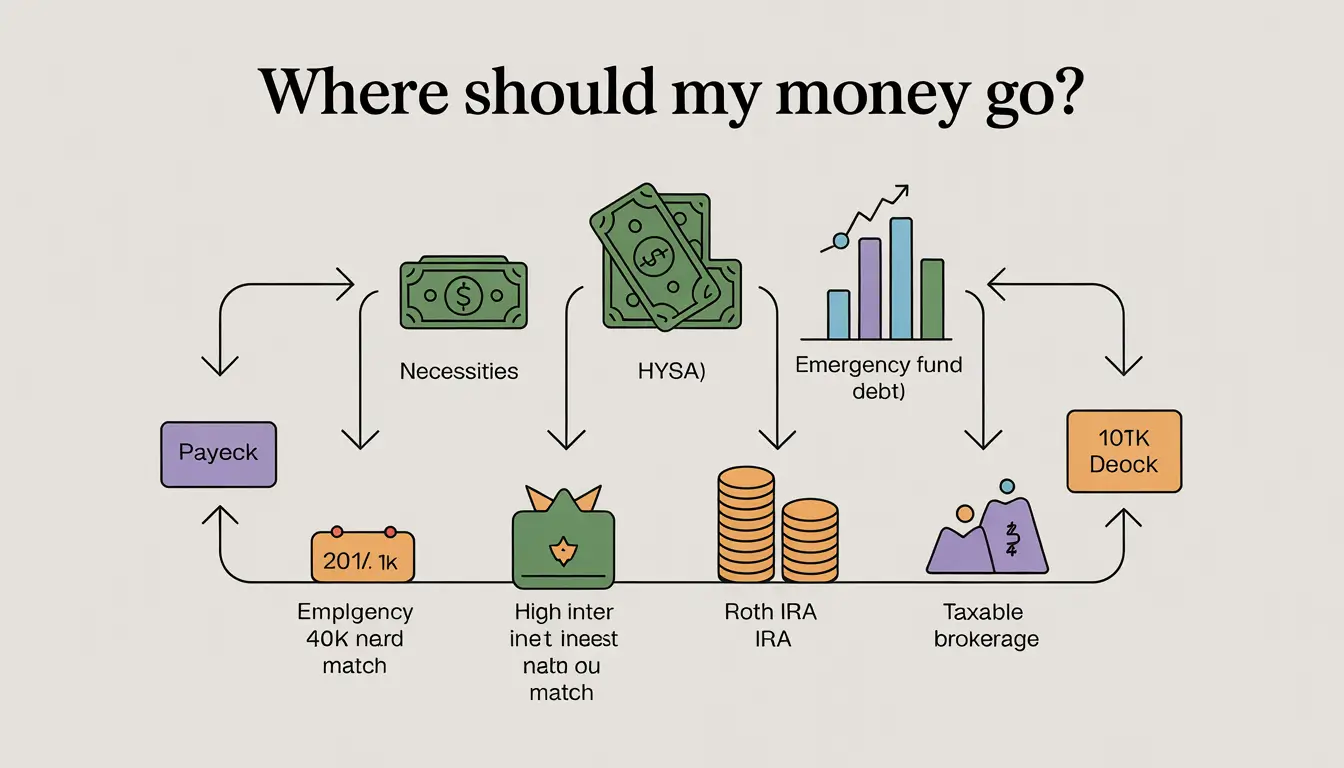
Do not rush to open a brokerage account before laying the groundwork. Follow this sequence to protect your downside.
Step 1: Build a High-Yield Buffer Before risking capital in the market, secure 3 to 6 months of living expenses in an FDIC-insured High-Yield Savings Account. This prevents you from having to sell stocks at a loss if your car breaks down.
Step 2: Crush Toxic Debt. If you have credit card debt at 24% APR, no investment strategy on earth will reliably outpace that. Pay this down first. It is a guaranteed 24% return on your money.
Step 3: Capture the “Free Money” Match. If your employer offers a 401(k) match, contribute exactly enough to get the full match. That is an immediate 100% return on your investment.
Step 4: Open a Tax-Advantaged Account (IRA). Open a Roth IRA via a reputable broker (like Fidelity, Vanguard, or Schwab). Contributions are made with after-tax money, but your investments grow completely tax-free, and withdrawals in retirement are tax-free.
Step 5: Automate Everything. Set up automatic transfers from your checking account to your brokerage account the day after you get paid. Buy your chosen ETFs automatically. If you don’t see the money, you won’t spend it.
(Looking for the right platform? Check out our AJH Nex guide on the 10 Profitable Online Business Ideas 2026 (Start Scaling Now).)
Mini Case Study: The Power of Compound Interest
Let’s look at two hypothetical investors to see why time in the market beats timing the market.
- Investor A (Starts at 25): Invests $200 a month into an S&P 500 ETF, earning an average 8% return. They stop contributing at age 35 (total invested: $24,000). By age 65, that money has grown to roughly $375,000.
- Investor B (Starts at 35): Invests $200 a month into the same fund. They contribute every month until age 65 (total invested: $72,000). By age 65, their portfolio is worth roughly $298,000.
The Takeaway: Investor A contributed $48,000 less of their own money but ended up with $77,000 more because they gave compound interest a 10-year head start. Read more about compound interest fundamentals at Investor.gov.
Pros & Cons of Active vs. Passive Investing
Passive Investing (Index Funds/ETFs)
- Pros: Lower fees, requires almost zero daily research, and historically beats the vast majority of active stock pickers over a 15-year horizon.
- Cons: You will never “beat” the market; you simply match it. It is entirely unexciting.
Active Investing (Picking Individual Stocks/Crypto)
- Pros: Potential for massive, market-beating returns. High engagement and educational value.
- Cons: Highly volatile, time-consuming, and emotionally taxing. Higher capital gains taxes if holding for less than a year.
How much money do I need to start investing?
You can start investing with as little as $1. Most major online brokerages in the USA now offer zero-commission trading and fractional shares, meaning you can buy a slice of high-priced stocks or ETFs regardless of your initial budget.
Is it safe to invest in the stock market right now?
The stock market always carries short-term risk and volatility. However, if your timeline is 10 to 20 years, historical data shows the market consistently trends upward. The real risk for long-term goals is leaving your money in cash and losing purchasing power to inflation.
Should I use a robo-advisor or pick my own stocks?
If you want a hands-off approach and lack the time to research companies, a robo-advisor is highly recommended. It automates diversification and rebalancing. Picking individual stocks is only recommended with a small "play money" portion of your overall portfolio.
How do I avoid losing money when investing?
You cannot eliminate risk entirely, but you can drastically minimize it through diversification. Do not put all your money into one company or sector. Use index funds, maintain a long-term perspective to ride out market dips, and never invest money you will need in the next 3 to 5 years.
Your Next Steps to Financial Freedom
Mastering investment strategies doesn’t require a Wall Street pedigree or a six-figure salary. As we navigate the financial landscape of 2026, the blueprint for success remains rooted in discipline: build your safety net, utilise tax-advantaged accounts like Roth IRAs, and let the quiet, relentless power of compound interest do the heavy lifting through broad-market ETFs.
The biggest mistake you can make right now isn’t picking the wrong stock—it’s waiting for the “perfect time” to start. Time is the ultimate currency in investing.
Take Action Today: Which strategy are you going to implement first? Are you leaning toward the “set-it-and-forget-it” ease of a Robot-Advisor, or are you ready to build your own Core and Satellite portfolio? Let us know in the comments below, and don’t forget to bookmark this AJH Nex guide for future reference as your portfolio grows.
