

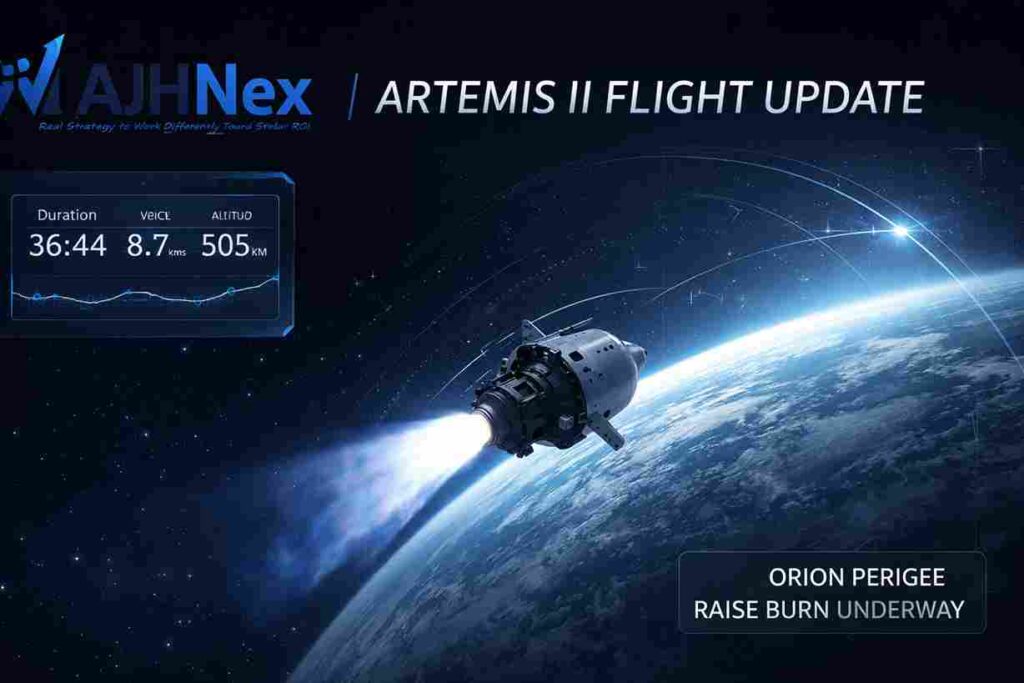
For the first time in 54 years, humanity is breaking free from low-Earth orbit. If you monitored the historic April 1, 2026, liftoff from Kennedy Space Center, you already know the monumental stakes. But what exactly happens after the 8.8-million-pound thrust of the Space Launch System (SLS) goes silent?
In this critical Artemis II flight update, we break down the exact orbital manoeuvres that guarantee a safe trajectory to the Moon and back. Why does this matter so much in 2026? Because mastering these initial flight phases—specifically the perigee raise burn and the delicate proximity operations (prox ops)—is the absolute linchpin. It is not just about keeping the four-person crew safe on their 10-day lunar flyby; it is about proving the deep-space navigation tech that will fuel the impending trillion-dollar commercial space economy.
Whether you are an aerospace professional, a deep-tech investor, or a dedicated space enthusiast, this guide gives you the definitive blueprint of the Artemis 2 mission’s crucial first 24 hours. Let’s dive into the data.
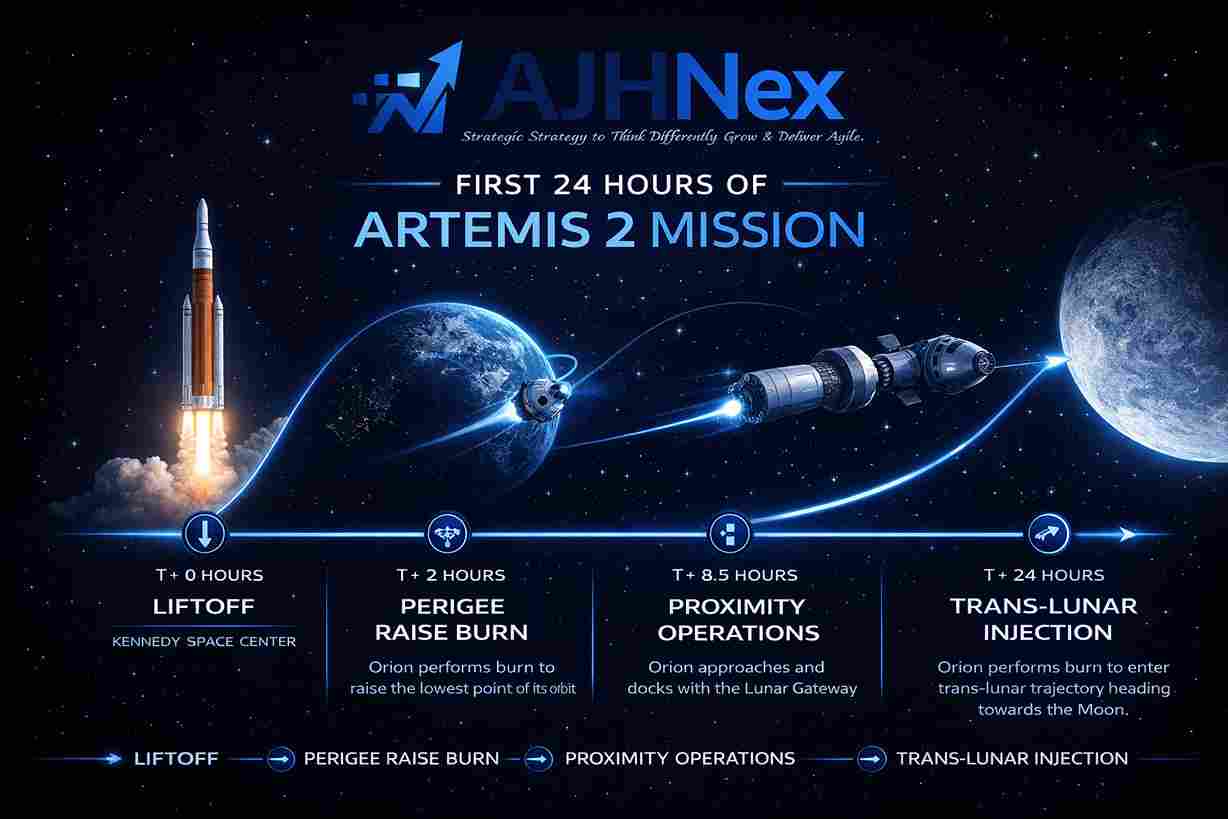
What is the Perigee Raise Burn?
Before the Orion spacecraft can safely leave Earth’s gravitational pull, it needs to ensure it doesn’t accidentally fall back into the atmosphere.
A perigee raise burn is a critical, precisely timed engine firing that lifts the lowest point (perigee) of a spacecraft’s highly elliptical orbit, placing it into a stable high-Earth orbit before deep-space injection.
Roughly 50 minutes after the spectacular Artemis II rocket launch, the Interim Cryogenic Propulsion Stage (ICPS) ignited its RL10 engine. This manoeuvre successfully raised Orion’s altitude, transitioning the capsule from an insertion trajectory into a stable, temporary parking orbit. This was the first major green light for NASA flight controllers in Houston.
The Real-World Impact in 2026
We aren’t just firing engines; we are testing the upper limits of cryogenic fuel management in zero gravity. The successful perigee and subsequent apogee raise burns confirmed that the launch vehicle’s upper stage functions flawlessly under crewed flight conditions—a massive relief following the hydrogen leak scares during the 2022 Artemis I test phase and early 2026 wet dress rehearsals.
The Proximity Operations Demonstration Explained
Once the altitude is secured, the crew cannot just sit back and coast. They have to prove that they can manually fly a 33,000-pound spacecraft. This is where the Proximity Operations Demonstration (Prox Ops) comes in.
Here is the exact sequence executed by Commander Reid Wiseman and Pilot Victor Glover:
Separation: Orion detaches from the spent ICPS upper stage.
Automated Backflip: The Orion capsule autonomously flips 180 degrees to face the floating ICPS.
Station Keeping: At approximately 300 feet away, Orion halts its relative motion.
Manual Override: Glover takes the rotational and translational hand controllers, transitioning from automated flight to manual piloting.
Close-Quarters Maneuvering: Using the reaction control system (RCS) thrusters on the European Service Module, the crew inches Orion to within 30 feet of a 2-foot target painted on the ICPS.
Departure Burn: After 70 minutes of testing the spacecraft’s fine handling qualities, Orion executes an automated departure burn, leaving the ICPS to eventually burn up in Earth’s atmosphere over the Pacific.
Why does this manoeuvre matter for investors? Because future missions (like Artemis III and IV) require Orion to dock with the Lunar Gateway space station and SpaceX’s Star ship Human Landing System (HLS). Proving manual docking capabilities now directly de-risks those future, highly commercialized contracts.
Enjoying this deep dive? Subscribe to the free AJH Nex Newsletter for weekly breakdowns of the business behind space, technology, and finance.
Spacecraft Showdown: Orion (2026) vs. Apollo CSM (1968)
To truly grasp the magnitude of this NASA Lunar Mission, we have to look at how much the technology has evolved.
| Feature | Artemis 2 Orion Spacecraft | Apollo Command/Service Module |
| Crew Capacity | 4 Astronauts (Up to 21 days) | 3 Astronauts (Up to 14 days) |
| Habitable Volume | 316 cubic feet | 210 cubic feet |
| Cockpit Tech | Glass cockpit, 3 screens, fly-by-wire | 2,000+ analog switches and dials |
| Power Generation | 4 deployable Solar Array Wings (63 ft span) | Fuel cells (Hydrogen/Oxygen) |
| Navigation | Optical navigation, star trackers, GPS | Sextant and ground-based radar |
Why the Artemis II Rocket Launch Matters
This isn’t just science; it’s the foundation of a new cis-lunar economy. The success of the Artemis 2 proximity operations provides a direct confidence boost to the aerospace supply chain. Lockheed Martin (builder of Orion), Airbus (builder of the European Service Module), and Boeing (core stage developer) all rely on these flight milestones to secure future government funding and private venture capital.
Are we seeing an immediate market impact? Absolutely. Every successful milestone of this NASA Lunar Mission solidifies the timeline for lunar surface mining, zero-G pharmaceutical manufacturing, and commercial satellite servicing.
The European Service Module (ESM) in Action
A vital component of this Artemis II flight update is the performance of the ESM, provided by the European Space Agency (ESA). During the Prox Ops, the ESM’s 24 reaction control thrusters were responsible for making those micro-movements.
In pre-flight ground testing, engineers simulated extreme thermal conditions. In actual flight, the ESM is currently maintaining thermal stability within 0.5% of predicted margins while efficiently generating power via its fully deployed 63-foot solar array wings. This real-world validation proves that international hardware integration is not just a diplomatic talking point; it is a highly functional reality.
Live Mission Milestones
What is a trans-lunar injection (TLI) burn? A TLI is the massive, prolonged engine firing that accelerates the spacecraft to roughly 24,500 mph (39,000 km/h), breaking it out of Earth’s orbit and slingshot ting it toward the Moon on a figure-eight free-return trajectory.
Will Artemis 2 land on the moon? No, artemis 2 will not land on the lunar surface. It is a 10-day orbital flyby mission designed to push human-rated life support and navigation systems to their limits before Artemis 3 attempts a surface landing.
Who is the crew of Artemis II? The historic crew consists of NASA astronauts Reid Wiseman (Commander), Victor Glover (Pilot), Christina Koch (Mission Specialist), and Canadian Space Agency astronaut Jeremy Hansen (Mission Specialist).
What other sites missed: Most generic news outlets simply report that the rocket launched. Here at AJH Nex, we bridge the gap by explaining how the proximity operations de-risk the commercial contracts of tomorrow. By understanding the perigee raise burn, investors and tech professionals can accurately gauge the hardware readiness level of the Orion capsule, directly correlating mission success to aerospace market stability in 2026 and beyond.
Are you tracking the explosive growth of the space economy? Don’t get left behind relying on delayed press releases.
Bookmark the AJH Nex Tech & Business Hub for real-time, expert-led analysis on the commercial space sector. The 2026 Aerospace Investment Framework DOWNLOAD SECURED -> Download our free 2026 Aerospace Investment Framework to see which tier-2 suppliers are benefiting from the Artemis program.
The successful execution of the perigee raise burn and the proximity operations demonstration proves that the Artemis II flight update is overwhelmingly positive. We have moved past the theoretical and back into the operational. For the first time in over half a century, a crewed spacecraft is fully configured, tested, and prepped to ride a trans-lunar injection all the way to the Moon’s far side.
The tech works. The international partnerships are holding. And the foundation for a permanent human presence in deep space is currently being laid at 17,500 miles per hour.
What are your thoughts on the commercial implications of this launch? Drop a comment below, share this breakdown with your network, and subscribe to AJH Nex to ensure you never miss a critical business or technology update.
