

By the end of this year, 20% of global organisations will use artificial intelligence to flatten their hierarchies, effectively eliminating more than half of current middle-management positions. Read that again. The conversation around AI and jobs is no longer a futuristic debate reserved for Silicon Valley boardrooms. This is an immediate, daily reality that affects your paycheck.
While legacy headlines panic over 92 million roles being displaced globally by 2030, they routinely bury the real story: 170 million entirely new roles are being created right alongside them. The AI workforce of 2025 and 2026 demands aggressive adaptation. Whether you are a corporate professional in Germany, a seasoned independent contractor in Canada, or a tech investor in the USA, your future earning potential depends entirely on how you leverage these tools today.
This guide cuts through the industry buzz, giving you a data-backed plan to protect your career, raise your freelance rates, and thrive in the evolving digital economy.
What Does the AI Workforce Transformation Actually Mean?
Before examining the strategies, we need a baseline understanding of what is actually happening to the labour market.
The intersection of AI and jobs refers to the structural transformation of the global labour market where artificial intelligence tools augment, automate, or replace specific human tasks. Rather than total unemployment, it marks a massive transition from manual task execution to AI management, requiring workers to prioritize strategy, emotional intelligence, and complex problem-solving.
The 2026 AI Job Automation Reality: What’s Gone and Growing
Are machines coming for your livelihood? Yes and no. The fear behind ai job automation is grounded in real projections, but it’s highly nuanced. By late 2025, 45% of US employees reported using generative AI to complete daily work tasks.
What happens when half the workforce becomes 40% more efficient? The demand for routine, repetitive output drops.
What is shrinking:
Entry-level administration: Demand for general office clerks and basic administrative roles is dropping sharply, with tasks easily handled by AI coplots.
Junior coding and QA: Entry-level hiring at major tech companies fell significantly over the last two years. Three-quarters of developers now use AI coding assistants, meaning one senior developer can do the work of three juniors.
Commodity content creation: Basic copywriting, stock graphic design, and simple translation are rapidly losing commercial value.
What is exploding:
AI Integration Specialists: Companies do not want raw AI; they want AI integrated into their existing CRM, supply chain, or HR software.
Data Curators and Ethics Managers: AI models hallucinate. Human-in-the-loop oversight is a massive growth sector.
High-Touch Human Services: Healthcare, complex B2B sales, and strategic leadership are seeing a premium placed on authentic human interaction.
AI Job Shift
| Pros for the Workforce | Cons for the Workforce |
| Increased Productivity: Average output per worker rises by 20-40% in knowledge domains. | Skill Obsolescence: Older or inflexible skill sets lose market value almost overnight. |
| New High-Paying Roles: Roles like ML Engineer or AI Strategist command salaries upwards of $150,000. | Middle-Management Squeeze: Organizations are flattening, reducing traditional stepping-stone promotions. |
| Four-Day Workweek Viability: Automation makes reduced working hours a realistic corporate policy. | Income Inequality: Highly-educated tech adopters pull rapidly ahead of those without digital access. |
AJH Nex: Want to stay ahead of these market shifts? Subscribe to the free AJH Nex weekly newsletter for exclusive, investor-grade breakdowns on enterprise tech trends and workforce data.
How AI Freelancing is Rewriting the Gig Economy
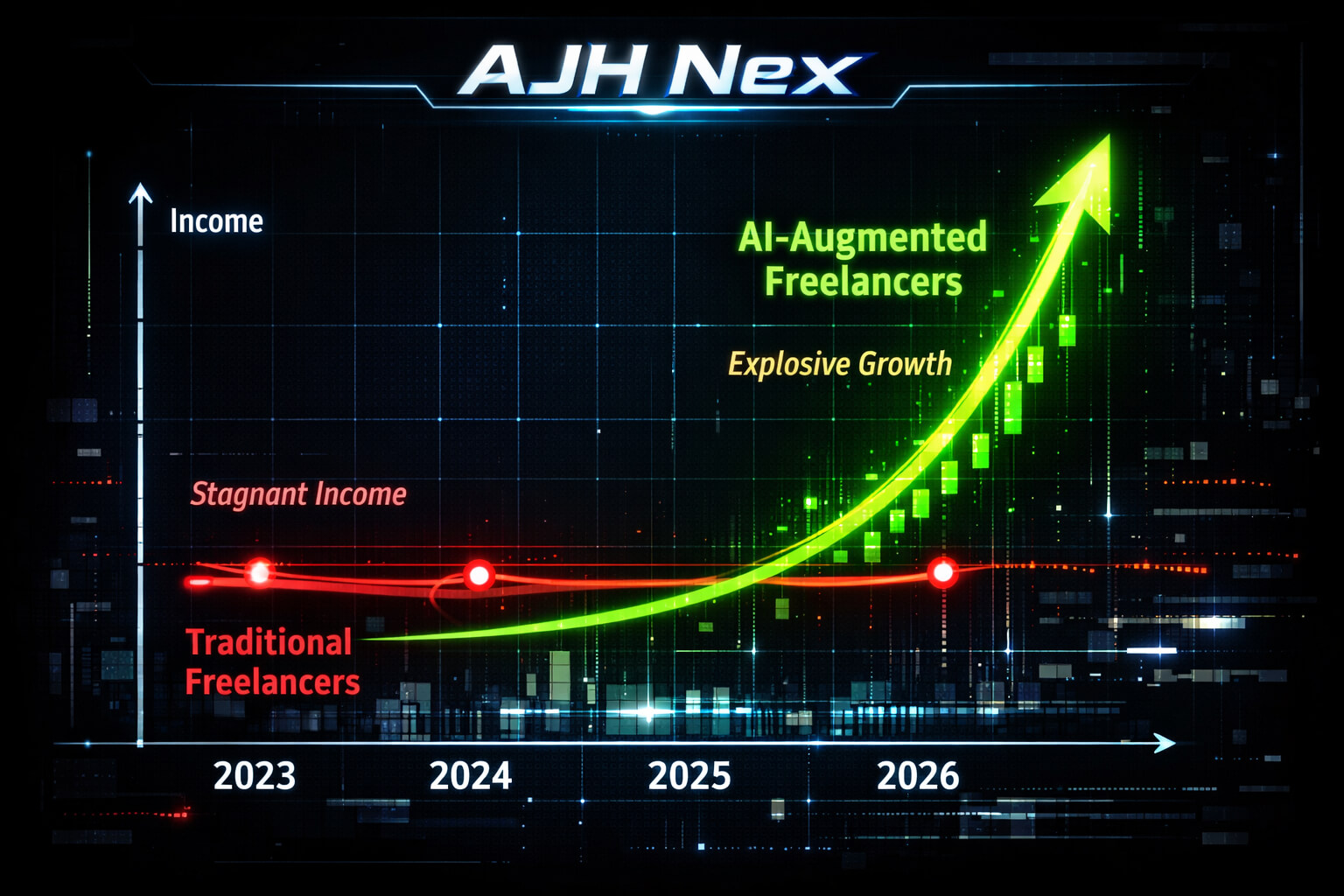
If corporate jobs are flattening, independent work is exploding. AI freelancing has morphed from a niche offering in 2023 to the most lucrative sector of the gig economy in 2026.
Recent platform data shows demand for AI and machine learning freelancers increased by over 1,800% in just three years. Why? Enterprises desperately need AI integration but cannot afford $300,000/year full-time engineers. They are turning to independent talent.
However, the traditional freelance model is fracturing. Studies show freelancers in categories heavily exposed to AI (like basic writing or data entry) saw a decline in contracts and earnings. The money hasn’t disappeared; it has moved to those who know how to wield the technology.
Traditional Freelancing vs. AI Freelancing (2026 Market)
| Metric | Traditional Freelancer | AI-Augmented Freelancer |
| Core Service | Manual execution (writing, coding, design) | Strategic implementation & automated workflows |
| Average Hourly Rate | $25 – $60 / hour | $80 – $250+ / hour |
| Delivery Speed | Days to Weeks | Hours to Days |
| Client Value Proposition | “I will do the work for you.” | “I will build a system that does the work.” |
The Pivot to Prompt Engineering
Consider the trajectory of a mid-tier SEO writer we’ll call David. In 2024, David charged $300 per article. By mid-2025, his client base eroded as agencies brought content generation in-house using custom GPTs.
Instead of lowering his rates, David audited his skills. He spent three months mastering the OpenAI API, advanced prompt engineering, and Zapier integrations. Today, David no longer sells articles. He sells “Automated Content Engines.” He builds custom AI workflows for marketing agencies, charging a $5,000 setup fee and a $1,000/month retainer for maintenance. He works half the hours and earns triple the income.
The “Agentic AI” Factor You’re Ignoring
Most career advice regarding future jobs ai tells you to “learn to write better prompts.” This is already outdated advice.
The real disruption in 2026 is the shift from Generative AI (tools that create text or images when you ask them to) to Agentic AI (autonomous systems that pursue complex goals without constant human intervention).
Agentic AI is now responsible for a massive portion of task displacement. An AI agent doesn’t just write a sales email; it scrapes a prospect’s LinkedIn, writes the personalized email, logs into your CRM, sends the message at the optimal time, reads the reply, and schedules the calendar invite.
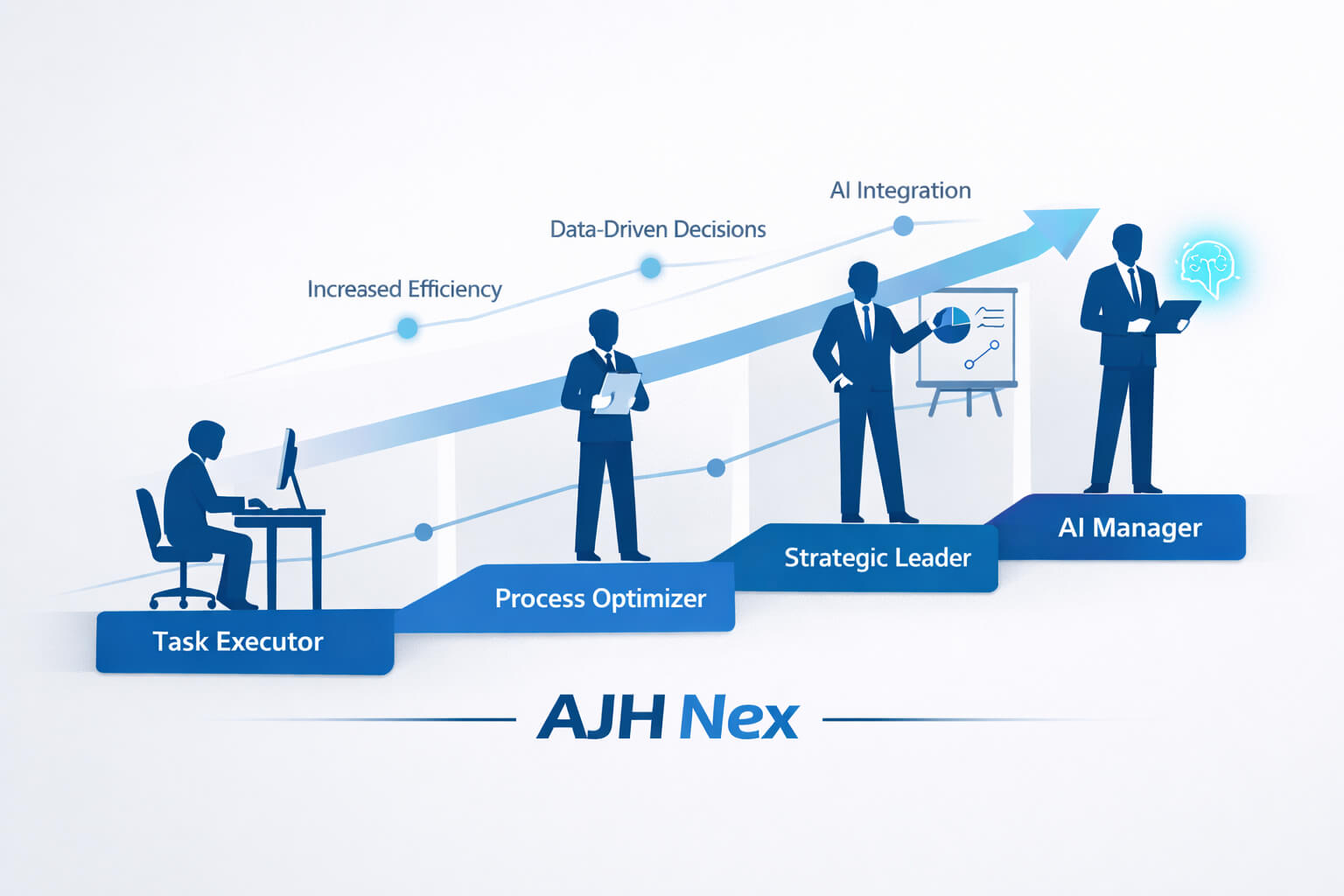
To secure your job, you must transition from a “Prompt Writer” to an “Agent Manager.” Your value will be judged by your ability to string together multiple AI agents, monitor their outputs for quality control, and direct their overarching strategy.
Securing Your Place in the Future Jobs AI Market
How do you practically future-proof your career starting today? Follow this three-step framework.
Step 1: Audit Your AI Exposure
Look at your daily workflow. Write down your top ten tasks. Which of these can a large language model do at 80% of your quality? If the answer is more than half, your current role is highly vulnerable. You need to identify the “human friction” in your job—the negotiations, the strategic pivots, the physical world interactions—and double down on those.
Step 2: Master Human-in-the-Loop Integration
Stop competing with the machine on speed. You will lose. Instead, become the essential middleman. Learn how to securely integrate AI tools into enterprise environments.
Key skills to acquire: Data privacy compliance, basic API integration (Python or Node.js), and AI output auditing (identifying hallucinations and bias).
Step 3: Build an AI-Augmented Portfolio
Whether you are seeking a promotion or a new freelance client, show, don’t tell. Build a tangible asset. Create a custom AI assistant that streamlines a specific bottleneck in your industry. (Pro tip: Looking for the right hardware to handle heavy local AI processing? Check out our 10 Profitable Online Business Ideas 2026 (Start Scaling Now) to ensure you aren’t bottlenecked by your own tech).
What is the highest paying AI freelancing niche right now?
AI Strategy and Consulting currently leads the market, commanding rates between $80 and $300 per hour. Businesses desperately need independent experts who can audit their workflows and implement custom AI API integrations securely.
How is AI job automation affecting middle management?
Organizations are using AI to flatten hierarchies. With AI handling project tracking, reporting, and data analysis, the need for managers whose primary job was simply funneling information upward is rapidly decreasing.
What are the best skills for the future jobs AI market?
Beyond technical skills like Python and API integration, the most valuable skills are "human-in-the-loop" capabilities: complex problem solving, emotional intelligence, ethical auditing, and managing autonomous AI agents.
Can beginners successfully start AI freelancing?
Yes. Beginners can start by offering AI workflow automation using no-code tools like Zapier combined with ChatGPT. As you build a portfolio, you can transition into more complex, high-ticket custom implementations and consulting.
The convergence of ai and jobs is not a zero-sum game. The technology is ruthlessly efficient at eliminating tasks, but it is entirely dependent on human ingenuity to define goals, ensure ethical compliance, and manage complex systems.
By understanding the realities of ai job automation, embracing the high-paying world of ai freelancing, and shifting your mindset toward managing Agentic AI, you position yourself at the forefront of the new economy.
What is your next move? Are you going to wait for your role to be automated, or are you going to build the system that does the automating? Drop a comment below with the first AI tool you plan to master this month, and share this guide with a colleague who needs a wake-up call.
