


Will AI replace jobs in 2026 USA?
Artificial Intelligence (AI) has infiltrated nearly every sector, fuelling fears that robots might soon take our jobs. So, will AI replace jobs in the USA in 2026? The short answer is: some jobs will change, but widespread Wipeout is unlikely. In fact, experts project that AI will reshape 50–55% of U.S. jobs in the next 2–3 years. That means workers will keep their roles but perform them differently, using AI as a tool. Only a smaller share (10–15%) of jobs is projected to be fully eliminated by around 2030.
These trends matter for 2025–2026 because AI adoption is surging: by late 2025, 88% of organisations worldwide were already using some form of AI. Almost half of U.S. workers report using AI at least a few times a year. Yet, despite this rapid uptake, large-scale layoffs have not materialised—and economists caution that any displacement will unfold gradually, not overnight. This guide breaks down the facts: which jobs are at risk, which are “AI-proof,” and what every American worker can do now to stay ahead.
- Key AI-job statistics (2025–26): 15% of U.S. jobs (≈23 million) are at high risk of displacement. Nearly 30% of companies say they’ve already used AI to replace jobs, and 37% expect to by the end of 2026. But hiring data show no evidence of mass unemployment yet.
- Most exposed roles: Routine, data-heavy, or predictable jobs face the highest exposure. For example, financial analysts, software developers, customer support agents, and entry-level clerks show early signs of AI-driven workforce shifts. A Stanford study found a 13% drop in early-career hiring in these AI-exposed fields since 2022.
- Safest careers: Hands-on, people-centric jobs are least automatable. Think electricians, plumbers, nurses, therapists, and teachers – roles requiring physical presence, complex judgment, or empathy. One analysis even identified “34 occupations AI could never do,” including power-line repair, athletes, and manual laborers.
- Impact in 2026 vs long-term: In the next year (2025–26), companies may shift some roles to AI, but overall employment is still growing. The U.S. Bureau of Labour Statistics projects employment to rise 3–4% by 2033, driven partly by tech and healthcare roles. Over the next five years, only 10–15% of jobs are at risk of elimination, according to a BCG model. The bigger effect will be on how jobs are done: workers will increasingly use AI tools, requiring new skills and workflows.
In short, AI will change the nature of work, but not instantly make millions of Americans jobless by 2026. Read on for data, trends, and practical advice every worker needs to know about the AI–jobs future. Read more our business related article on 10 Profitable Online Business Ideas 2026 (Start Scaling Now)
What Do We Mean by “AI Replacing Jobs”?
AI (Artificial Intelligence) refers to computer systems that perform tasks requiring human-like intelligence, from pattern recognition to decision-making. When people talk about AI replacing jobs, they usually mean automation – machines or software taking over tasks that humans used to do. But it’s important to clarify: Not all tasks in a job are equally vulnerable. Many roles contain a mix of routine tasks (e.g. data entry, scheduling) and uniquely human tasks (e.g. creative thinking, interpersonal interaction). AI is already great at routine cognitive tasks (analysis, writing, coding assistance), but it still struggles with unpredictable, hands-on, or deeply social tasks.
The “reshaping vs replacing” viewpoint is key. Consultants at BCG find that in the next few years, about half of U.S. jobs will be reshaped by AI. That means workers will keep working, but in an AI-augmented way: for instance, a marketer using AI to generate drafts, or an accountant letting AI automate number-crunching. By 2030, only around 10–15% of jobs might be fully eliminated (about 16–25 million jobs out of ~165 million, by BCG’s estimate). Those will be the positions where all key tasks can be automated. For example, some entry-level data processing roles or call-canter jobs might shrink substantially.
In contrast, experts and research currently see limited evidence of mass job displacement to date. Analyses of 2023–2025 data show that overall employment is still holding steady or growing, even in sectors where AI is widely used. What we observe instead are shifts in job content and hiring: many companies are cautious, opting to train employees on AI or create new roles (e.g. data analysts, AI ethicists) alongside some selective layoffs. In short, “will AI replace jobs?” is not a yes/no question—it’s about which tasks and which roles will change vs disappear.
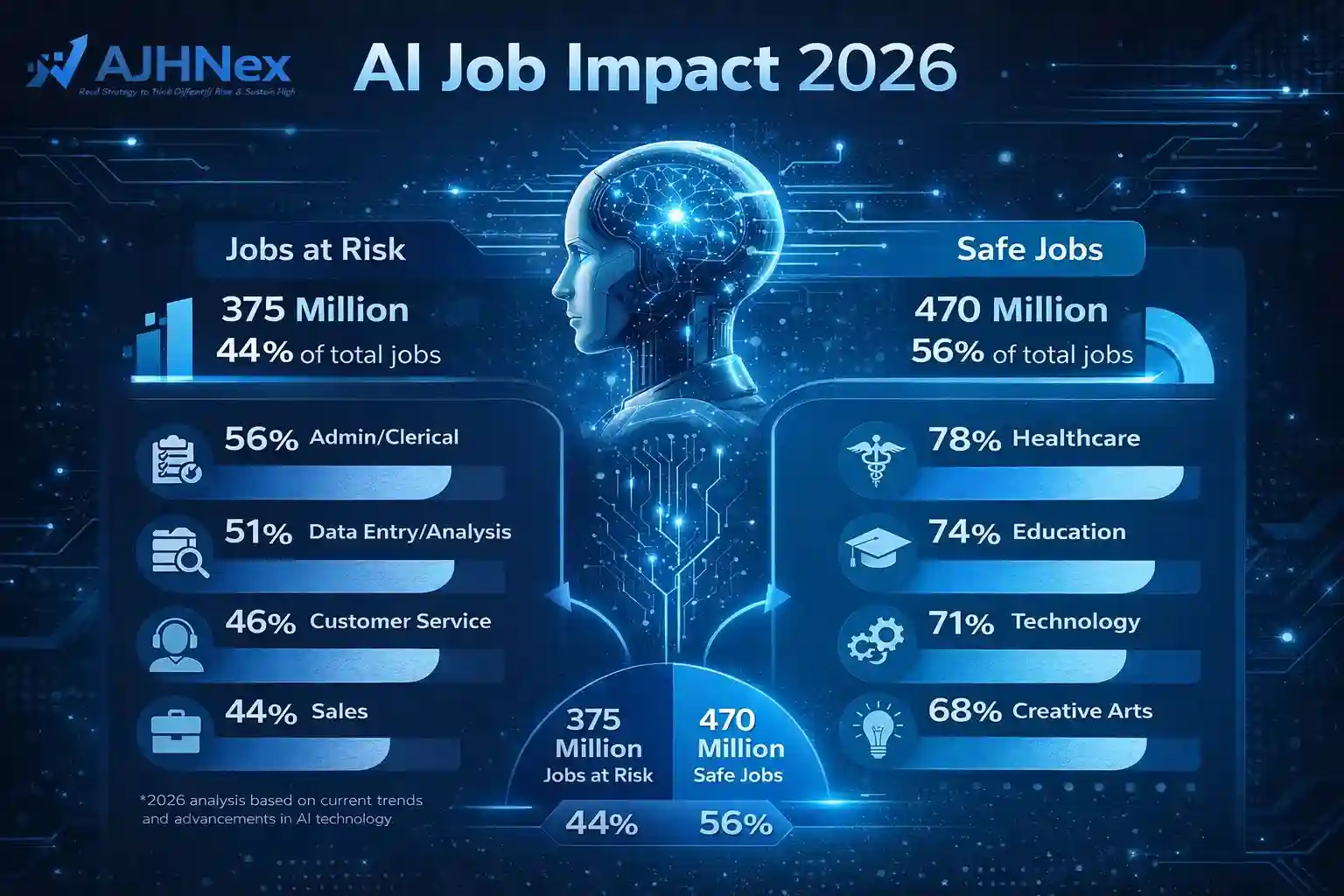
Current AI Adoption and Workforce Trends (2025–2026)
Will AI replace jobs in 2026 USA: AI adoption in the U.S. has skyrocketed. By 2025, over four-fifths of U.S. companies were using AI in some capacity. Generative AI tools like ChatGPT and Bard have spread faster than any previous tech (53% adoption in 3 years, versus decades for PCs or internet). Stanford’s 2026 AI Index reports that 88% of organizations worldwide (and 90% in North America) use AI in at least one business function (Chart below). In the U.S., a 2026 Gallup survey found that 50% of employees report using AI at least a few times a year, and 41% say their company has integrated AI into operations.
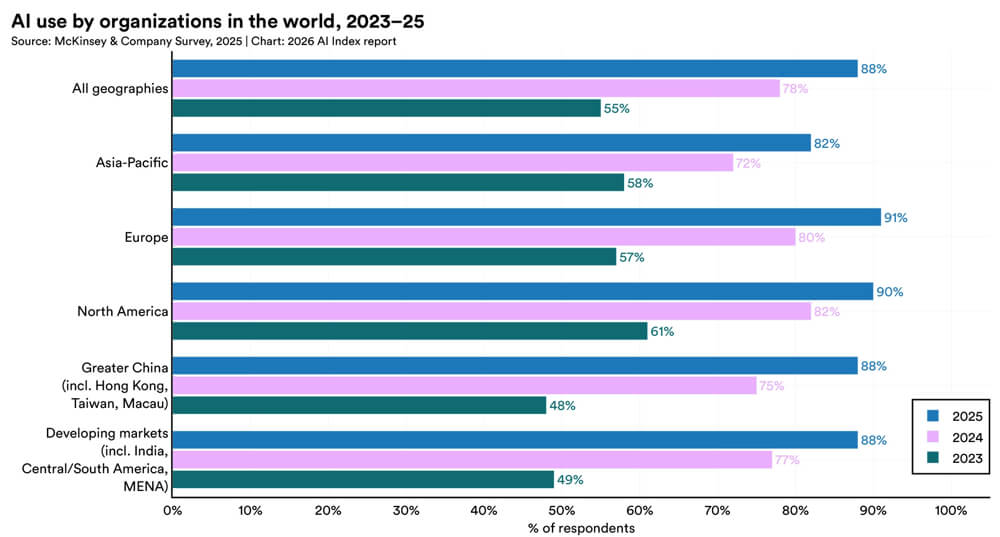
Chart: AI adoption by organizations, 2023–25 (Stanford HAI). By 2025 nearly 88% of companies globally – 90% in North America – are using AI in some business function.
With these tools in place, how are workers feeling? Surveys show mixed impacts. Many employees who use AI report productivity gains (65% say it improves efficiency), especially knowledge workers. But only a minority say AI has transformed their entire job. Leaders and technical professionals notice more change, while service and administrative workers see less impact. In short, AI is making many tasks easier, but companies are still figuring out how to redesign work around AI.
Meanwhile, companies are planning workforce changes. In a September 2025 HR survey, 37% of U.S. firms said they expect to replace jobs with AI by end of 2026. Already, about 29% have used AI to replace some jobs. The highest-risk positions are routine or tech-focused roles. Notably, high-salary workers without AI skills, plus new and entry-level hires, were said to face the most layoffs. But other data give pause: most HR leaders are training workers on AI tools rather than cutting staff, and broader labour-market indicators haven’t shown mass unemployment yet. A Dallas Federal Reserve analysis found no sign of widespread job losses yet, even in AI-exposed fields, suggesting major shifts may take years, not months.
In summary: U.S. businesses are investing aggressively in AI (trillions in projected productivity gains), and many expect to rework jobs. Yet large-scale displacement hasn’t happened yet, and experts stress the need for balanced strategies (reskilling, workflow redesign). The job market in 2026 is one of transition: AI is here, but humans still play a central role.
Which Jobs Are Most Exposed to AI?
Not all occupations face equal risk. AI is most effective at automating predictable, routine tasks. Studies show that jobs involving lots of data processing, standardized rules, or simple decision-making are most exposed. For example:
- IT and Finance: Software developers and financial analysts have many tasks (coding, reporting, number-crunching) that AI can assist or automate. In fact, a 2024 Science journal study flagged fields like software development, data processing, financial investment roles as highly exposed. Recent data back this up: Stanford’s analysis found early-career tech and customer service hires declined ~13% since 2022 in these fields.
- Office/Clerical Jobs: Roles like data entry clerks, mail carriers, receptionists, and bookkeeping clerks involve repetitive processing of information. For instance, invoicing, scheduling, and standard customer queries are now often handled by AI-driven tools. A BLS report warns that clerical support occupations could decline if automation accelerates.
- Customer Service: Many first-line customer service tasks can be done by chatbots or automated phone systems. Simple FAQs, appointment scheduling, and status checks often no longer need a human. (However, complex or high-empathy service still relies on people.)
- Manufacturing & Warehouse: Robots and AI systems in factories and warehouses can handle assembly, packing, and sorting. Warehouse roles (forklift driving, inventory) are increasingly automated by AI-guided systems.
- Entry-Level White-Collar: Several reports note that junior roles in banking, insurance, and law are vulnerable. For example, insurance underwriting and routine legal research can be partly automated. The biggest layoffs seen in 2025 were actually among early-career analysts at big banks deploying AI.
SHRM (HR Association) estimates that 15% of U.S. jobs (about 23 million) involve at least 50% automation capability. They find that nearly 40% of software development jobs and “mathematical” roles (like financial analysis) have high automation exposure. By contrast, only ~7% of education and library work is that exposed.
Still, “exposed” doesn’t mean “gone overnight.” The U.S. Bureau of Labour Statistics projects strong growth even in many tech fields (software dev up 17.9% from 2023–33). AI often augments demand: better productivity can expand markets, creating new jobs. BCG’s model highlights this “demand effect” – if AI makes products cheaper or faster, companies might grow and hire differently.
In short, think jobs at risk = those built on routine cognitive tasks. If your work follows strict rules or processes data, expect AI involvement soon. Examples of highly exposed jobs include:
- Software, IT, & Data: Programmers, data entry, QA testers.
- Finance & Accounting: Bookkeepers, payroll clerks, loan officers, junior analysts.
- Legal Support: Paralegals, contract administrators (for routine document review).
- Customer Support: Call-canter agents handling simple queries.
- Manufacturing/Logistics: Line workers, machine operators (increasingly aided by AI/robots).
However, even in these fields, AI typically automates tasks not whole jobs. For example, AI may write code snippets, but developers still design systems; it may draft legal memos, but lawyers interpret and strategize. The key takeaway: jobs can be redefined, not always erased. People who adapt by focusing on complex tasks and oversight will ride the wave.
Which Careers Are Safest from AI?
Conversely, certain jobs are least likely to be replaced, at least in the near term. Surveys and studies agree: AI struggles with jobs requiring hands-on physical presence, complex human judgment, or personal interaction. For instance, a 2026 Investopedia analysis (citing University of Pennsylvania research) identified the “AI-proof” occupations. The top of that list includes electrical power-line installers/repairers, athletes, pile-driver operators, and other skilled manual workers. Why? These jobs need physical dexterity in unpredictable environments – something AI/robots aren’t good at (and they often involve safety-critical tasks).
More broadly, safe jobs share certain traits:
- Physical, Manual Tasks: Plumbers, electricians, carpenters, gardeners, and other trade professions involve tactile skills and on-the-spot problem solving. AI may assist with blueprints or diagnostics, but cannot fully replicate manual craft and on-site decisions.
- Healthcare & Caregiving: Doctors, nurses, dentists, therapists, and personal care aides rely on empathy, ethical judgment, and hands-on care. AI can help diagnose or organize patient data, but it can’t deliver care physically or comfort patients emotionally.
- Education & Social Work: Teachers, social workers, psychologists, and clergy provide human connection, guidance, and mentorship. While AI tools can supplement teaching or counselling, they can’t replace the human relationships that are core to these roles.
- Creative Professions: Artists, designers, writers, and performers involve human creativity and originality. AI can generate content, but it lacks true creativity or the ability to channel uniquely human experiences. (Even AI art and music require human curation and prompts.)
- Leadership & Skilled Trades: Senior managers, entrepreneurs, and skilled professionals (chefs, pilots, engineers in the field) exercise nuanced judgment, leadership, and complex decision-making. They integrate many inputs and adapt to novel situations – areas where human insight still rules.
In their report, SHRM notes that “client preferences” protect many service roles: people often prefer dealing with a person rather than a machine. So, jobs cantered on interpersonal skills or unpredictable human needs are relatively safe.
To illustrate, here are examples of surprisingly AI-proof jobs:
- Electricians/Power-line workers: High pay, high risk (safety), and heavily manual. An AI can’t yet climb a pole to fix power lines.
- Healthcare Providers: Surgeons and nurses use tools, but empathetic care and fine motor skills are irreplaceable.
- Educators and Trainers: Teaching involves inspiring and understanding each student; AI tools can only assist.
- Artists and Designers: Creativity and cultural nuance still elude AI.
- Mental Health Counsellors: Therapy and counselling require genuine empathy and trust.
- Skilled Craftsperson: Chefs, hairdressers, plumbers, and mechanics rely on hand skills and interacting with clients.
The University of Pennsylvania study on “34 AI-proof jobs” concludes: “These are hands-on roles requiring your physical presence, manual labour, or work in highly unpredictable environments, leaving little for AI to automate.”
That said, “safe” doesn’t mean 100% untouched. Even doctors now use AI-assisted imaging, and artists use AI tools for new ideas. The point is that AI is least effective in these domains. Workers in safe fields often find ways to integrate AI to boost, not threaten, their work. For example, teachers use AI to grade quizzes, then spend more time mentoring students – improving productivity without losing jobs.
How Will AI Shape the Job Market by 2026?
By 2026, we expect a mixed picture: some jobs will shrink, others will grow, and many will evolve. Here’s what the latest projections and studies suggest:
- Overall Job Growth Continues: The U.S. Bureau of Labour Statistics projects total employment to rise about 3–4% between 2023 and 2033 (millions of new jobs, despite automation). This growth is driven by population growth, rising healthcare needs, and technology expansion. In many fields where AI is used, demand for workers remains strong. For example, software developers are projected to grow 17.9% from 2023–33, far faster than average. Banks are still hiring financial advisors even as robo-advisors take over simple tasks, expecting 17.1% growth in that occupation. BLS notes that AI often creates more demand, since cheaper or better services (via AI) lead to business expansion.
- Roles Will Be Redefined: Many existing jobs will incorporate new AI tasks. For example, accountants now spend less time on manual bookkeeping and more on financial strategy with AI tools. Managers will hire AI-literate analysts and demand softer skills (communication, creativity). Expect to see new hybrid roles by 2026, such as AI supervisors, prompt engineers, and data ethicists in many industries. A resume.org survey predicts “entirely new categories of work cantered on AI oversight, data ethics, prompt engineering and human–AI collaboration.”.
- Labour Displacement Patterns: The effects will not be uniform. Early trends (Stanford AI Index 2026) show young tech workers are feeling the pinch: employment for software developers aged 22–25 fell nearly 20% by 2025. Many employers expect to reduce staff in service operations, supply chain and software engineering. On the other hand, jobs in industries with labour shortages (healthcare, construction) are still growing and may see AI as a supplement, not a substitute.
- Skills In Demand: As AI tools become ubiquitous, workers will need digital fluency and adaptability. Soft skills will rise in value: critical thinking, emotional intelligence and complex problem-solving will differentiate employees. Employers will look for people who can work alongside AI – those who know what tasks to automate and which require a human touch. (For instance, engineers who understand AI constraints, or customer service reps who excel at conflict resolution.)
- Regional and Sector Differences: In the USA/Canada/Germany, rates vary. The U.S. leads in AI investment and adoption. Canada’s public sector is studying exposure to prepare (e.g. pwc reports on Canadian AI impact). Germany’s industry, heavily automotive and manufacturing, is adopting AI at a measured pace, with a focus on industrial robots. Global reports suggest developed economies will face similar waves of AI change, though individual job markets will reflect their local industries (e.g., manufacturing in Germany, tech in USA).
What won’t happen by 2026: a complete collapse of the labour market. A new Federal Reserve study concludes that fears of imminent mass AI unemployment are likely overblown. Indeed, “It would be unprecedented if a new technology had massively disrupted the workforce in three years,” notes an expert. History shows major tech shifts (like the internet) also took a decade or more to fully transform jobs. So most workers have time to adapt.
By 2031–2033, BCG expects only 10–15% of jobs might be outright eliminated (if ~165 million U.S. jobs). In the shorter term (to 2026), changes will be more evolutionary: for example, resume.org found 37% of companies plan some layoffs due to AI by 2026, but many more will upskill existing staff. A Federal Reserve Bank of New York survey even reports most employers will train workers on AI rather than fire them. The consensus: prepare and pivot, rather than panic.
By 2026, we expect a mixed picture: some jobs will shrink, others will grow, and many will evolve. Here’s what the latest projections and studies suggest:
- Overall Job Growth Continues: The U.S. Bureau of Labor Statistics projects total employment to rise about 3–4% between 2023 and 2033 (millions of new jobs, despite automation). This growth is driven by population growth, rising healthcare needs, and technology expansion. In many fields where AI is used, demand for workers remains strong. For example, software developers are projected to grow 17.9% from 2023–33, far faster than average. Banks are still hiring financial advisors even as robo-advisors take over simple tasks, expecting 17.1% growth in that occupation. BLS notes that AI often creates more demand, since cheaper or better services (via AI) lead to business expansion.
- Roles Will Be Redefined: Many existing jobs will incorporate new AI tasks. For example, accountants now spend less time on manual bookkeeping and more on financial strategy with AI tools. Managers will hire AI-literate analysts and demand softer skills (communication, creativity). Expect to see new hybrid roles by 2026, such as AI supervisors, prompt engineers, and data ethicists in many industries. A resume.org survey predicts “entirely new categories of work centered on AI oversight, data ethics, prompt engineering and human–AI collaboration.”.
- Labour Displacement Patterns: The effects will not be uniform. Early trends (Stanford AI Index 2026) show young tech workers are feeling the pinch: employment for software developers aged 22–25 fell nearly 20% by 2025. Many employers expect to reduce staff in service operations, supply chain and software engineering. On the other hand, jobs in industries with labour shortages (healthcare, construction) are still growing and may see AI as a supplement, not a substitute.
- Skills In Demand: As AI tools become ubiquitous, workers will need digital fluency and adaptability. Soft skills will rise in value: critical thinking, emotional intelligence and complex problem-solving will differentiate employees. Employers will look for people who can work alongside AI – those who know what tasks to automate and which require a human touch. (For instance, engineers who understand AI constraints, or customer service reps who excel at conflict resolution.)
- Regional and Sector Differences: In the USA/Canada/Germany, rates vary. The U.S. leads in AI investment and adoption. Canada’s public sector is studying exposure to prepare (e.g. pwc reports on Canadian AI impact). Germany’s industry, heavily automotive and manufacturing, is adopting AI at a measured pace, with a focus on industrial robots. Global reports suggest developed economies will face similar waves of AI change, though individual job markets will reflect their local industries (e.g., manufacturing in Germany, tech in USA).
What won’t happen by 2026: a complete collapse of the labor market. A new Federal Reserve study concludes that fears of imminent mass AI unemployment are likely overblown. Indeed, “It would be unprecedented if a new technology had massively disrupted the workforce in three years,” notes an expert. History shows major tech shifts (like the internet) also took a decade or more to fully transform jobs. So most workers have time to adapt.
By 2031–2033, BCG expects only 10–15% of jobs might be outright eliminated (if ~165 million U.S. jobs). In the shorter term (to 2026), changes will be more evolutionary: for example, resume.org found 37% of companies plan some layoffs due to AI by 2026, but many more will upskill existing staff. A Federal Reserve Bank of New York survey even reports most employers will train workers on AI rather than fire them. The consensus: prepare and pivot, rather than panic.
AI in the Workplace
Real-world examples illuminate these trends.
- Banking (USA): Major banks like Goldman Sachs and JPMorgan reported cutting entry-level analyst positions as they deploy AI for data analysis and reporting. These firms also upskill some juniors to manage AI models instead. The net effect has been slower hiring of new grads (unemployment for recent college grads reached 4.8% in late 2025, vs 4% overall).
- Healthcare (USA/Canada): Many hospitals use AI tools for imaging (radiology), diagnostics, and paperwork. For example, an AI app assists radiologists in Germany to analyze CT scans. However, no hospital has eliminated doctors or nurses en masse. Instead, staff spend less time on routine tasks and more on patient interaction. Some health systems retrain billing clerks to become care coordinators, combining medical and data roles.
- Manufacturing (USA/Germany): Automotive factories (e.g. in Detroit or Stuttgart) introduced AI-guided robots on assembly lines. This displaced some repetitive roles (welding, painting), but demand for maintenance technicians and AI programmers grew. In Canada, auto plants use AI to optimize supply chains, but still hire lots of assembly workers due to parts shortages. Germany’s strong unions help manage transitions, pushing companies to preserve skilled jobs by retraining.
- Tech Sector (USA/Canada/Germany): Software companies everywhere are integrating AI. Google and Microsoft report that many employees use AI copilots daily (writing code faster). While some junior programmers see reduced demand, others are transitioned to AI-support roles. Tech hubs like Silicon Valley and Berlin actually show high AI adoption with job creation in data science and cloud infrastructure.
- Retail/Services: Fast-food chains are experimenting with AI ordering kiosks and automated kitchens. Some cashier roles are reduced, but companies also invest in customer experience roles (like delivery coordinators, online marketing). A coffee shop in Toronto, for example, replaced one cashier with an app, but hired two baristas and a delivery driver.
These cases show patterns: AI tools displace parts of jobs, but often create new tasks or roles. Companies that succeed are those that redeploy human talent – training staff to work with AI, not against it.
How to Future-Proof Your Career
Facing AI, workers can take proactive steps:
- Upskill with AI: Learn to use AI as a productivity tool. For example, journalists can use AI for initial research; salespeople use AI to analyze markets. Free online courses (many industry associations offer AI training) can boost your competence. AJH Nex [CTA: See our AI Bootcamp for Professionals].
- Cultivate Human Skills: Focus on the aspects AI can’t replicate easily – empathy, creativity, leadership, critical thinking. Highlight these in your job and interviews.
- Stay in the Loop: Follow AI news in your industry. Subscribe to newsletters (e.g. AJH Nex AI Career Insights) to know what tools employers are using.
- Adapt Roles: Think about how your job could change. If an AI can do 30% of your tasks, focus on the 70% that’s uniquely human. For instance, if you’re an accountant, shift from manual ledger entry to financial advising.
- Lifelong Learning: The half-life of skills is shrinking. Regularly add new competencies (data analysis, AI ethics, remote collaboration tools). Many workers thrive by “leveling up” their roles – the WEF Future of Jobs report 2025 found that tech-driven roles (AI/machine learning specialists, information security, data analysts) are among the fastest-growing.
- Network and Adapt: Talk to peers who are already using AI. See what tools they like. Sometimes internal workshops or external webinars can give insights. Don’t isolate yourself in tradition.
By 2026, opportunity often trumps fear. Businesses also need people to run the AI systems! Employers know that 60–70% of AI projects fail without proper talent. So they’re keen on workers who can bridge AI and business goals. Your value comes from combining experience with willingness to learn.
Quick Tip: Experiment with AI on your own. Tools like ChatGPT, MidJourney (for designers), or industry-specific AI demos are free. See what tasks they handle well and where they fall short. This will help you articulate the uniquely human value you bring, and even discover new efficiencies to pitch to your boss.
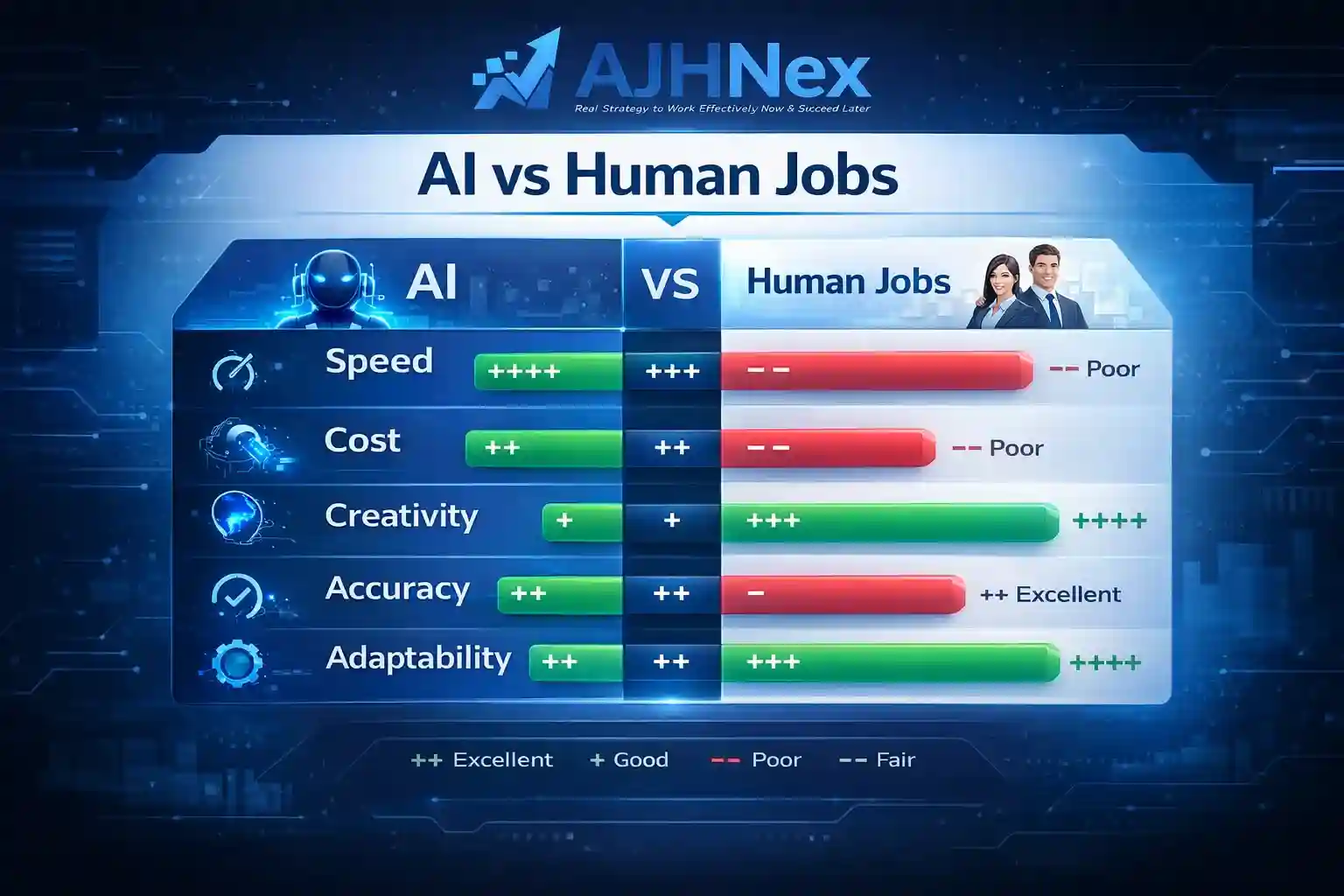
Q: Which US jobs are safe from AI?
A: Jobs involving manual skills or human interaction are safest. Think electricians, plumbers, nurses, teachers, and therapists. These require unpredictable human judgment, empathy, or hands-on work. Even if AI enters your field, roles that emphasize creativity, care, or complex decision-making are likely to remain in demand.
Q: How many US jobs will AI replace by 2026?
A: No exact number is certain. Some surveys suggest tens of millions are at risk, but actual replacements will be much smaller in the short run. For example, the HR Dive survey found 37% of companies plan some AI layoffs by 2026. A BCG model estimates only 10–15% of jobs (perhaps 16–25 million) might be eliminated over 5 years. In practice, the U.S. economy is still projected to add jobs overall. The next couple of years (2025–26) will likely see modest job shifts rather than a wipeout.
Q: Will AI create new jobs?
A: Absolutely. While AI automates some tasks, it also creates demand for new skills. Expect roles in AI development, data analysis, cybersecurity, and AI ethics/compliance to grow. One industry report noted that by 2030 up to 70% of companies will use AI, generating jobs in overseeing and fine-tuning those systems. Moreover, every efficiency AI brings (like cheaper products) can spur new business areas. Economists often say technology creates more jobs than it destroys in the long term.
Q: How can I prepare my career for AI?
A: Start by learning basic AI literacy. Familiarize yourself with the tools used in your field. Seek training or courses in data analysis, machine learning concepts, or digital tools. Emphasize learning agility and problem-solving. Employers highly value adaptability, so highlight any tech-savvy projects or upskilling you’ve done. Networking is also key: discuss with peers how they’re using AI. Finally, lean into uniquely human strengths – communication, creativity, leadership – and consider roles that combine them with technology (e.g. project manager overseeing AI projects).
Conclusion
AI won’t instantly overthrow the labor market in 2026, but it will reshape the future of work. Data shows some sectors and jobs are more vulnerable than others, yet most roles will evolve rather than vanish. The shocking truth is, fear alone won’t halt AI – but adaptation can ensure it lifts careers, not crush them. American workers who proactively learn AI tools and emphasize their human skills will stay ahead of the curve.
Key takeaways:
- Stat: BCG finds 50–55% of U.S. jobs will be reshaped by AI by 2028; only about 10–15% eliminated by then.
- Stats: 18% of U.S. workers fear AI will eliminate their job in 5 years, but so far “scant evidence” of mass layoffs.
- Trends: By 2025 most firms have some AI usage. Companies report partially replacing jobs with AI (27–37% plan it), but many choose to upskill staff instead.
- Advice: Upskill, experiment, and focus on human-centric tasks. Use AI to boost your productivity, not worry it will wholly replace you.
The AI revolution is inevitable, but workers are not powerless. By understanding which jobs are at risk and building skills that complement AI, you can turn potential disruption into opportunity. Stay curious, stay prepared, and use AI as a tool for growth.
Enjoyed this guide? Share your thoughts or experiences in the comments below, and subscribe to AJH Nex’s newsletter for more insights on AI and careers.
Sources: This article combines findings from Gallup, BCG, SHRM, Stanford HAI, U.S. BLS projections, Investopedia, HR Dive, Brookings/Anthropic, and industry analyses, among others. All data are updated for 2025–2026.
