

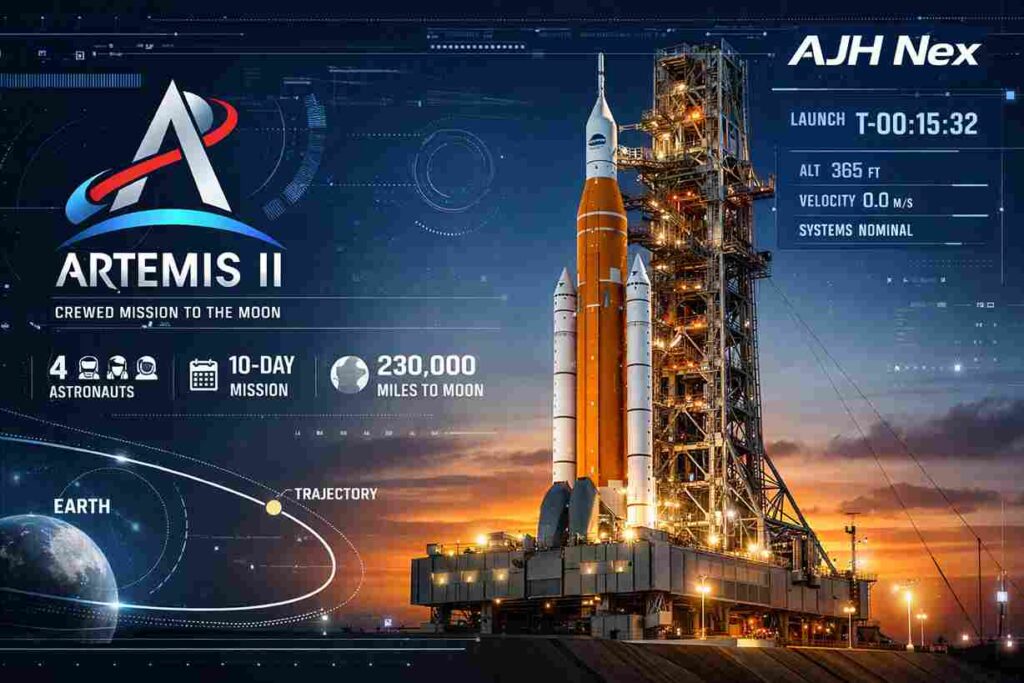
Did you know that by the time you finish reading this article, the Space Launch System (SLS) rocket will be undergoing its final cryogenic fuel checks on Launch Pad 39B?
More than 50 years after Apollo 17, humans are finally heading back to deep space. The NASA Artemis II launch is officially targeted for a launch window opening on April 1, 2026. But this isn’t just a scientific milestone; it’s a multi-billion-dollar geopolitical and commercial pivot point.
For aerospace professionals, tech enthusiasts, and investors watching the spacetech market, the stakes have never been higher. With new NASA Administrator Jared Isaacman at the helm and a radical shift in upcoming SpaceX launch dates, the 2026 lunar landscape has evolved dramatically.
Here is everything you need to know about the mission, the tech, the delays, and where the smart money is moving in 2026. Read more about other categories post Arnold Schwarzenegger Son Joseph Baena: 2026 Fitness Legacy
🛰️ What is the NASA Artemis II Launch?
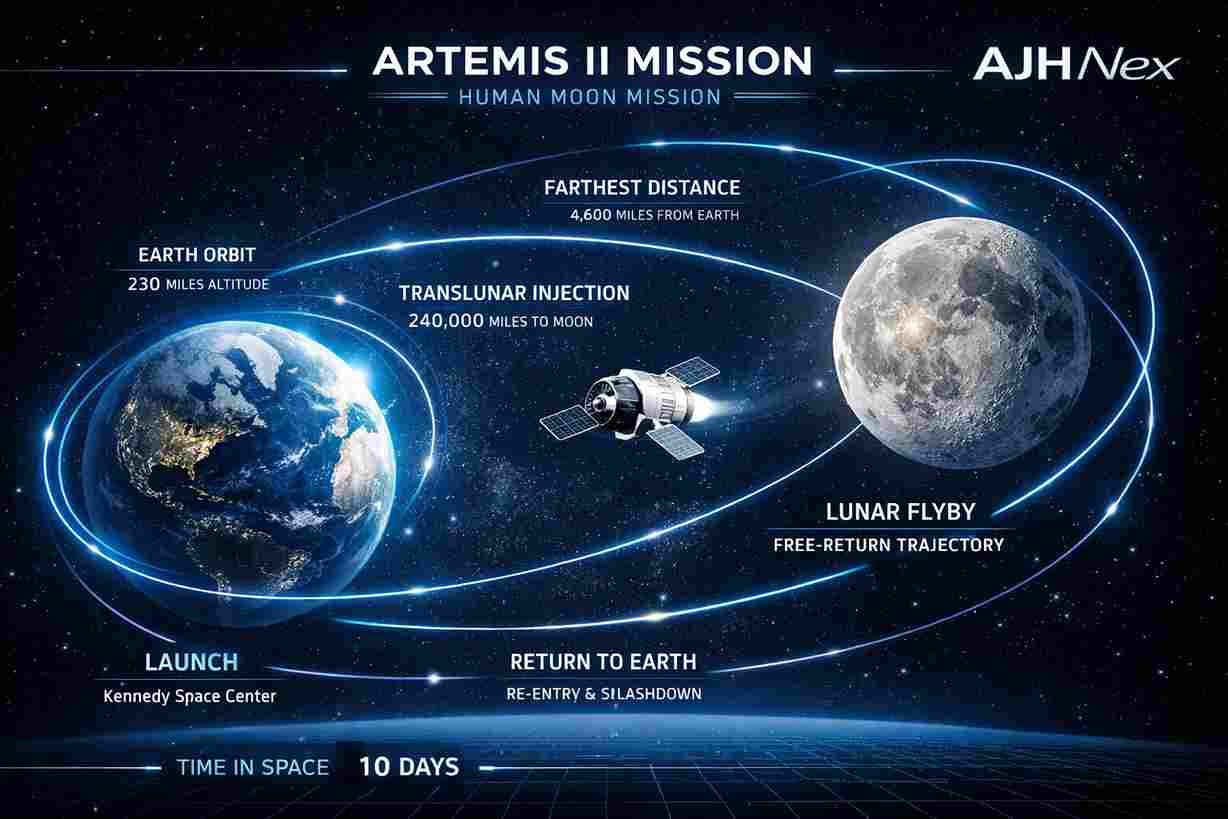
Snippet Answer: The NASA Artemis II launch is the first crewed mission of the Artemis program. Scheduled for April 2026, it will send four astronauts aboard the Orion spacecraft, propelled by the Space Launch System (SLS) rocket, on a 10-day lunar flyby to test life support and navigation systems before future moon landings.
Unlike Artemis I (an uncrewed test in 2022) or the Apollo landings, Artemis II will not land on the moon. It uses a “free-return trajectory,” traveling 4,700 miles beyond the far side of the Moon. This will set a new record for the farthest humans have ever travelled into space.
🗓️ NASA Moon Mission 2026 Launch Date: The Timeline
If you’ve been following the news, you know this mission has faced its share of hurdles. Originally slated for late 2024, and then late 2025, rigorous safety protocols pushed the NASA moon mission 2026 launch date into the spring.
Here is the finalized step-by-step launch preparation timeline for early 2026:
Mid-January 2026: Rollout to Launch Complex 39B at Kennedy Space Center.
February 2 & 24, 2026: Wet dress rehearsals. Teams encountered and subsequently fixed critical liquid hydrogen fuel leaks.
March 12, 2026: Flight Readiness Review (FRR) completed. Seven two-hour launch windows established.
March 27, 2026: Astronaut crew arrives at Kennedy Space Center and enters “soft quarantine.”
April 1, 2026 (6:24 p.m. EDT): Primary targeted launch window opens.
🧑🚀 Meet the Historic Artemis II Crew
The Artemis II crew represents a massive shift from the Apollo era, marking several historic firsts for human spaceflight:
Commander Reid Wiseman (NASA): Veteran naval aviator and former Chief of the Astronaut Office.
Pilot Victor Glover (NASA): The first person of color to leave low-Earth orbit (LEO).
Mission Specialist Christina Koch (NASA): The first woman to travel beyond LEO, holding the record for the longest single spaceflight by a woman.
Mission Specialist Jeremy Hansen (CSA): The first non-American (Canadian Space Agency) to travel to deep space.
🚀 The Tech Behind the Launches: SLS vs. SpaceX
As the Artemis program scales, NASA is relying heavily on both legacy contractors (Boeing, Lockheed Martin) and commercial pioneers (SpaceX, Blue Origin).
If you are evaluating aerospace efficiency, understanding the difference between the government-owned SLS and commercial heavy-lifters is crucial.
Comparison: SLS vs. SpaceX Starship (2026 Data)
| Feature | NASA Space Launch System (SLS) | SpaceX Starship (HLS Variant) |
| Primary Role | Launching Orion & Crew to Lunar Orbit | Lunar Lander / Cargo Transport |
| Reusability | Fully Expendable (Single Use) | Fully Reusable |
| Estimated Cost per Launch | ~$2.2 Billion – $4 Billion | ~$100 Million (Estimated long-term) |
| Current Mission Focus | Artemis II (April 2026) | Artemis III (Mid-2027) |
| Thrust at Liftoff | 8.8 million lbs | 16.7 million lbs |
📈 The Spacetech Market: An Investor’s Guide to 2026
For professionals and investors tuning in from the USA, Canada, and Germany, the space economy is no longer science fiction. It is a tangible, highly volatile asset class.
The nasa artemis ii launch acts as a catalyst for a broader ecosystem. While Boeing and Lockheed Martin remain defense staples, the real momentum in 2026 is in cryogenics, orbital refueling, and commercial space stations.
Watch the IPOs: With Morgan Stanley front-running the highly anticipated SpaceX IPO “bake-off” in late 2025/early 2026, liquidity is flooding into spacetech.
Component Manufacturers: Companies specializing in 3D-printed rocket engines (like Agnikul Cosmos) are slashing production times by 90%.
Orbital Logistics: As Artemis III prepares to test low Earth orbit rendezvous, startups focusing on in-orbit refueling and life-support cryogenics are seeing massive venture capital inflows.
Disclaimer: AJH Nex does not provide financial advice. Always conduct your own due diligence before investing in aerospace equities.
🔬 Mini Case Study: Overcoming the Cryogenic Leaks
The Problem: Storing super-cold liquid hydrogen ($LH_2$) and liquid oxygen ($LOX$) at extreme temperatures causes metal to shrink, creating microscopic gaps where highly pressurized fuel can escape. During the February 2026 wet dress rehearsal, NASA detected intermittent hydrogen leaks in the interface routing propellant to the core stage.
The Solution: Instead of risking a catastrophic failure, NASA paused. They executed a rollback, replaced the faulty seals, and adjusted the cryogenic loading procedures to allow the hardware to chill down more gradually.
The Result: The follow-up late-February test was flawless. This methodical approach highlights NASA’s zero-tolerance policy for risk when human lives are aboard—a stark contrast to the “move fast and break things” iterative testing of the commercial sector.
🌌 What Happened to the SpaceX Launch Date for Artemis III?
If you are searching for the SpaceX launch date regarding the Artemis lunar landing, you need the latest 2026 update.
Originally, Artemis III was billed as the mission that would return humans to the lunar surface. However, under the new NASA Administrator Jared Isaacman, the architecture was officially revised in February 2026.
Artemis III (Mid-2027): This mission will no longer land on the moon. Instead, it will be a low Earth orbit (LEO) test mission to rendezvous with SpaceX’s Starship HLS (Human Landing System) and potentially Blue Origin’s Blue Moon lander.
Artemis IV (2028): This is now slated as the first potential crewed lunar landing mission.
This pivot ensures that SpaceX has the necessary time to perfect orbital refueling—the complex process required to get Starship all the way to lunar orbit.
⚖️ Pros & Cons of the Current Artemis Strategy
Is the current approach to deep space exploration the right one? Let’s break it down objectively.
Pros:
Unmatched Safety: Methodical testing ensures astronaut survival.
International Alliance: Involves the ESA, CSA, and JAXA, fostering global cooperation.
Commercial Stimulation: Billions of dollars are trickling down to private sector contractors, driving innovation in AI, materials science, and robotics.
Cons:
Exorbitant Costs: The SLS rocket is single-use, making it financially unsustainable for high-frequency launches.
Agonizing Delays: Constant timeline shifts frustrate the public and investors alike.
Geopolitical Pressure: China is actively targeting the lunar South Pole for 2030, making any further US delays a strategic risk.
Q2: Will the Artemis II astronauts walk on the moon?
A: No. Artemis II is a lunar flyby mission. The four-person crew will travel 4,700 miles beyond the far side of the moon to test the Orion spacecraft's life support systems before returning to Earth.
Q3: What rocket is being used for the Artemis II launch?
A: The mission uses NASA’s Space Launch System (SLS), currently the most powerful operational rocket in the agency's fleet, producing 8.8 million pounds of thrust at liftoff.
Q4: How has the SpaceX launch date for Artemis III changed?
A: As of early 2026, the Artemis III mission featuring the SpaceX Starship Human Landing System (HLS) has been repurposed. It will launch in mid-2027 to conduct docking and rendezvous tests in low Earth orbit, delaying the actual lunar landing to Artemis IV in 2028.
Q5: Why was the Artemis II mission delayed to 2026?
A: NASA delayed the mission to 2026 to ensure absolute crew safety. The extra time allowed engineers to address issues with the Orion crew module's life support systems, heat shield ablation, and cryogenic fuel leaks on the SLS rocket.
🎯 Conclusion & Next Steps
The nasa artemis ii launch is more than just a rocket leaving the pad—it is the proving ground for humanity’s permanent expansion into the solar system. By April 2026, we will watch four astronauts push the boundaries of deep space travel, setting the stage for orbital refueling, commercial lunar landers, and eventually, Mars.
Whether you are tracking the engineering marvels of the SLS or positioning your investment portfolio for the upcoming spacetech boom, the next few years will be historic.
What’s next for you? If you found this guide valuable, don’t miss our next breakdown. Bookmark AJH Nex, and let us know in the comments below: Do you think the shift to rely on commercial landers for Artemis III is the right move for NASA?
